

Same Page SF | Dispatches from the SF Art Book Fair
Aku Ammah-Tagoe reads the room

“Bubbly, irreverent, generous, and a good time with 40,000 friends at our annual art book camp.” - Aku Ammah-Tagoe
Welcome to this bonus edition of Same Page SF, your home for all things local and literary.
For nearly three years (!) I’ve been writing to you every Monday, sharing book-related happenings for the week ahead. But until now, Same Page has always been forward-looking; there hasn’t been a way to collectively reflect on what’s passed.
That changes today with Same Page’s first READING THE ROOM, a retrospective, idiosyncratic, 100% human recap. (Thanks to Oakland Review of Books’ Vibe Reports for the inspiration!)
Our inaugural report is by Aku Ammah-Tagoe, a writer, interviewer, and educator here in San Francisco. (That’s her official one-liner; I’d add that, while I’ve only known her a few weeks, it’s clear there’s no one better with whom to discuss K-pop, fan culture, and English lit!)
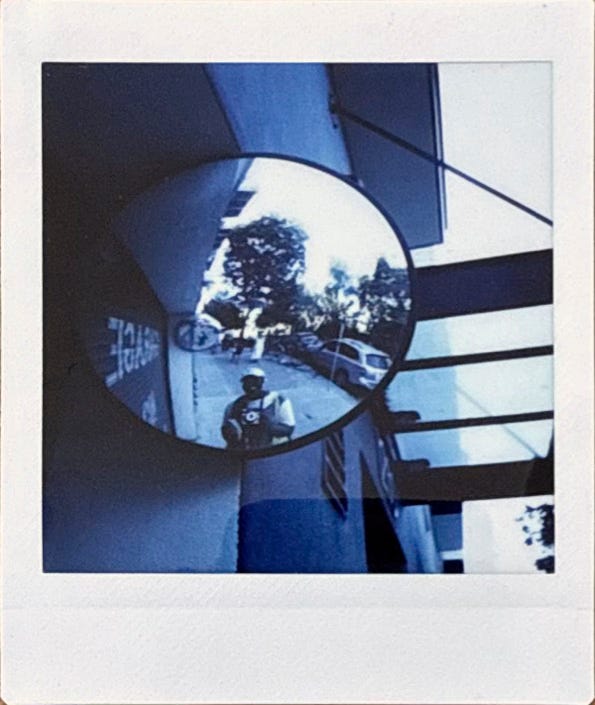
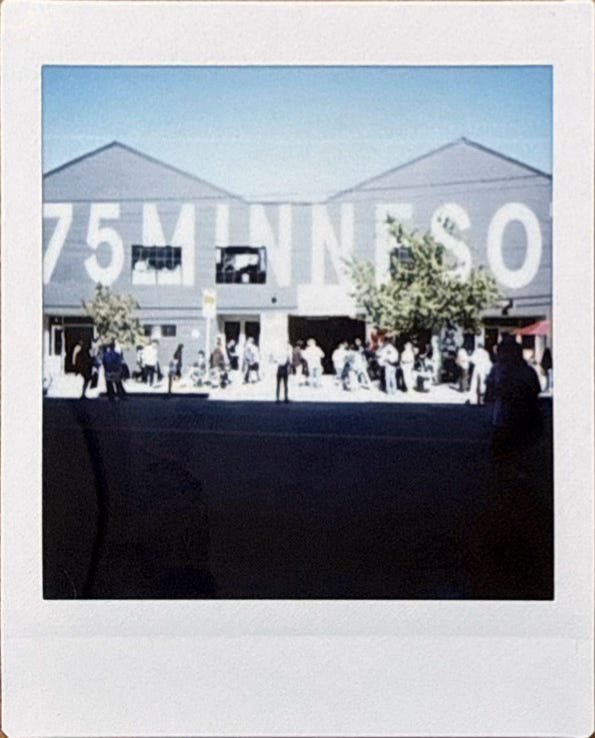
Aku revisits the San Francisco Art Book Fair, an annual four-day celebration of print culture, art books, and independent publishing. It gathers artists, book-lovers, and creatives from around the world in three cavernous buildings and a range of studio spaces at Minnesota Street Project, an art gallery complex in the Dogpatch.
This year, the festival ran from July 23-26, and Aku attended every day. In her words:
As a fan of books who also loves visual art and publishing, this is my favorite event in San Francisco, and I’ve visited or volunteered at the fair every year since 2016. (There were no in-person fairs in 2020 and 2021.)
Though in past years I’ve dropped in for a day or two, this year I decided to immerse myself from start to finish. Technically four days, it felt like a week at the center of an art, print, and book scene that is animated, brainy, openhearted, and impossible to pin down.
Read on to feel like you were there. Thanks, Aku!
THURSDAY
The night begins with a flying leap as Michael-Vincent D’Anella-Mercanti, a former ballet dancer, launches himself off Minnesota Street into the arms of a friend. Michael-Vincent directs communications and advocacy for the Friends of the San Francisco Public Library, and is unofficially a friend to everyone in the literary arts. In lieu of having a plan, he’s the perfect extrovert to attach to.
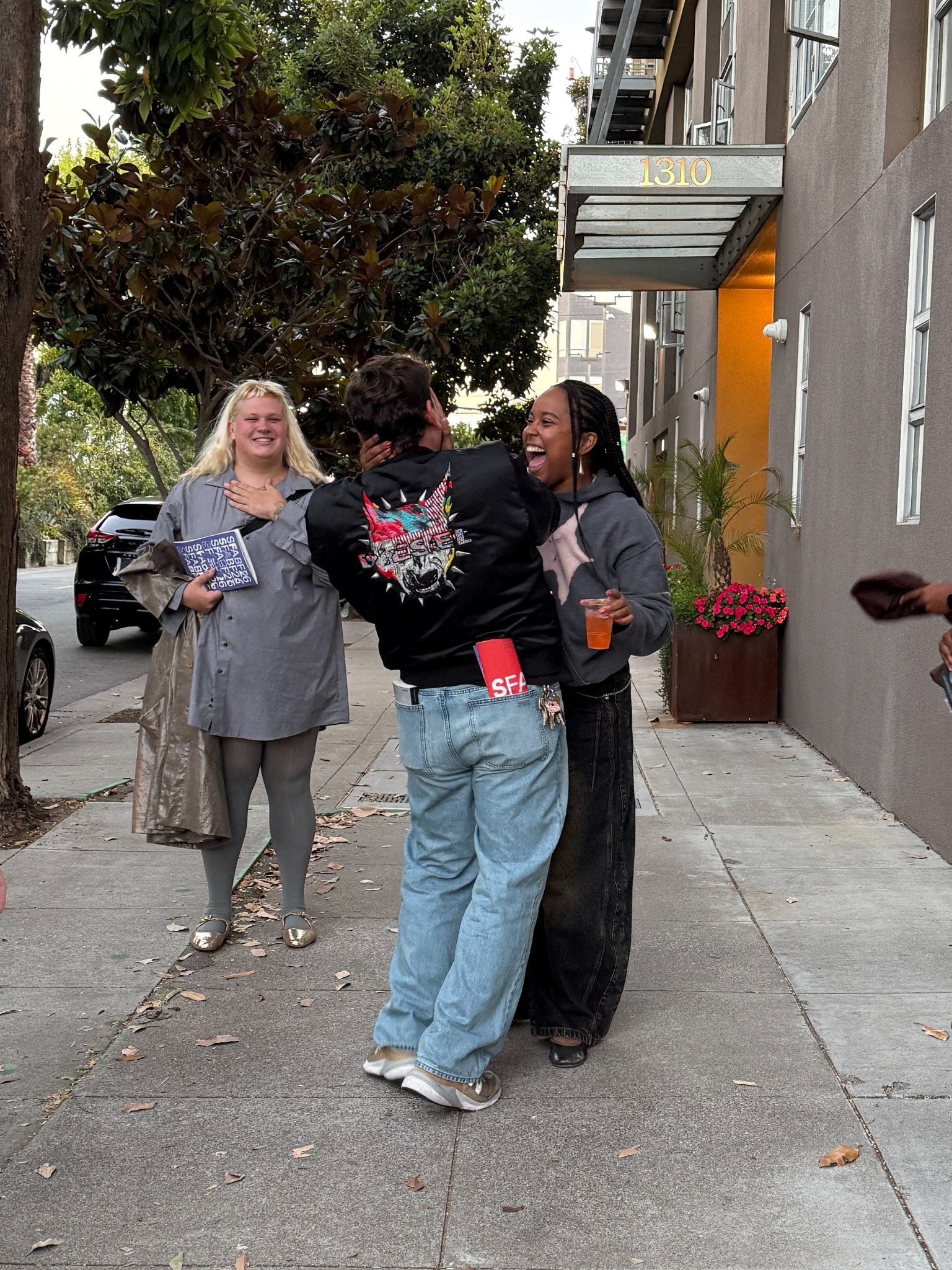
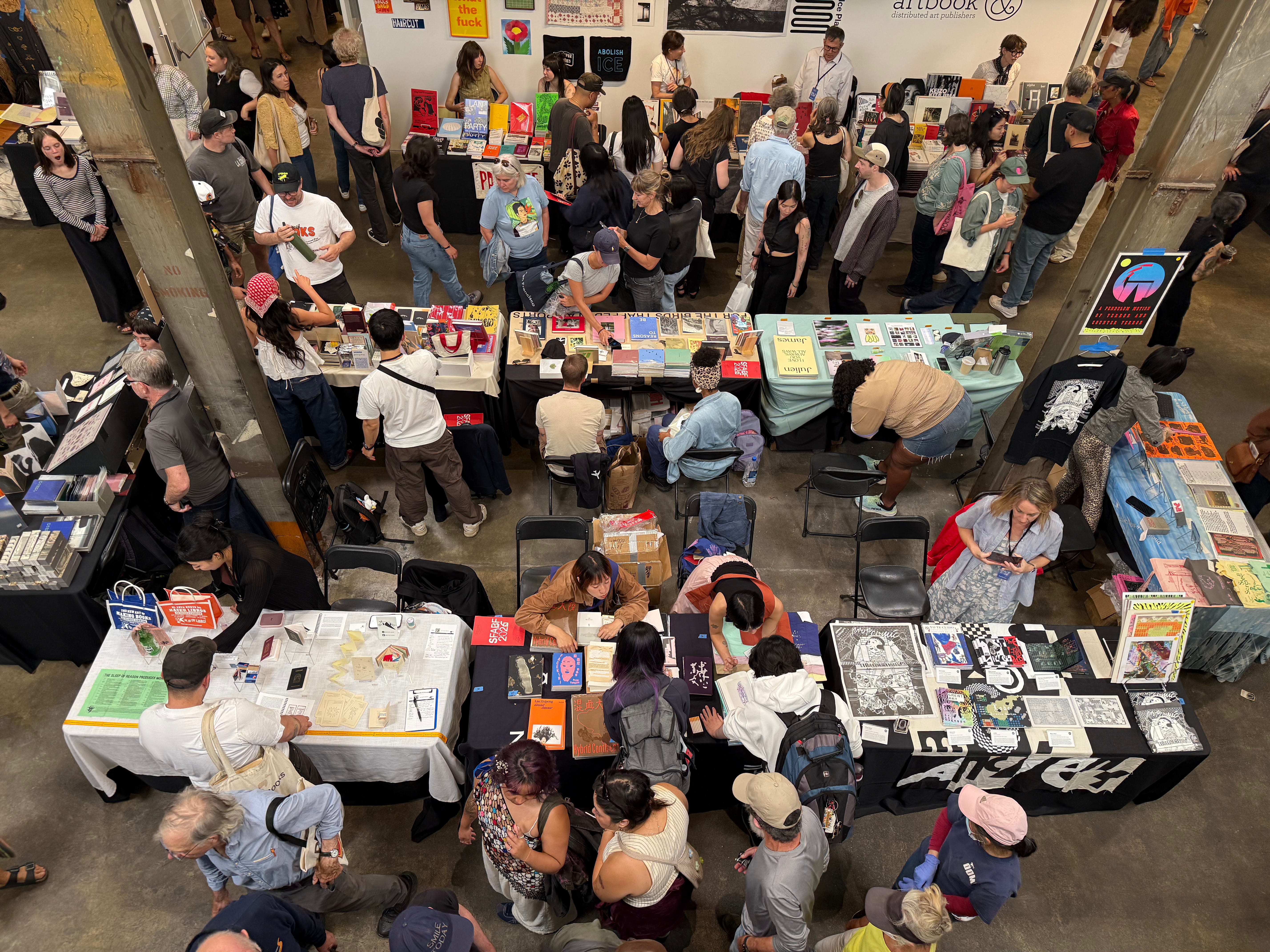
In official materials, Thursday is listed as a preview; exhibitors are still arriving and programming hasn’t fully begun yet. But to level-set, it’s a party, with people spilling onto the sidewalks outside 1275 Minnesota St., 1201 Minnesota St., and 1150 25th St. This is the rare literary event that resembles a night out, or Pride weekend in Dolores Park. Cell signals are intermittent, and the crowd is dressed in wide-legged pants, structured jackets over alternative tees, bookstore tote bags, and skirts made alternately of natural fibers and gauzy synthetics.
I walk with Michael-Vincent, collecting friends and acquaintances along the way. People naturally gather towards the center of the fair, the main Minnesota Street Project (MSP) building at 1275 Minnesota. It’s an elegant, multi-story atrium with rows of exhibitors on the ground floor overlooked by art galleries upstairs. This physical framing is part of SFABF’s distinctive character: we’re surrounded by fourteen independently curated galleries, many of which stay open for the weekend and offer multiple prisms that filter what we’re encountering.
Part of the crowd heads down the block to 1201 Minnesota, where the early consensus is that the exhibitors — organized this year around zine publishers and printmaking — are exciting and varied enough to make a standalone fair. Our small group fractures in the massive crowd. To my right, the folks from Lower Grand Radio huddle over a small lasagna with a single birthday candle. I follow them as they present it to Sanaa Khan of Tiny Splendor, a beloved Berkeley studio that has taught printmaking or sold prints to a high percentage of this crowd, myself included.
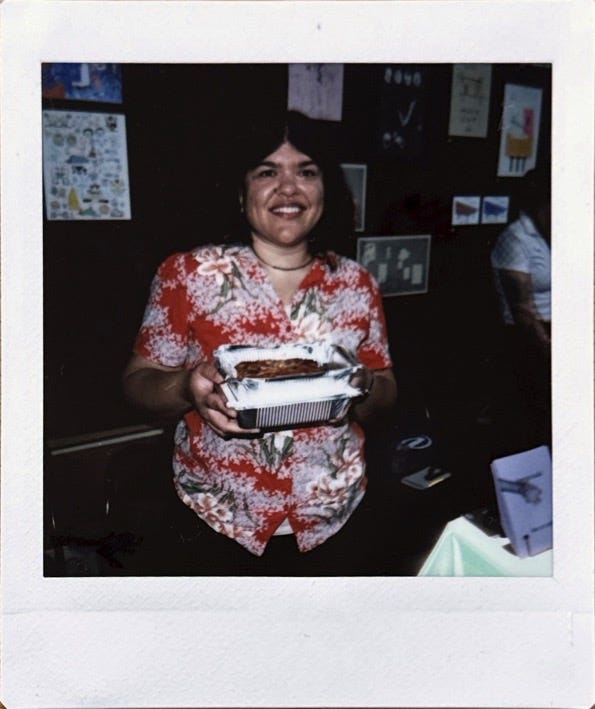
Sanaa, like most of the exhibitors I speak with, says it’s been a crazy day, with just about six hours for exhibitors to arrive, set up, and start interacting with visitors. The room’s energy feels bright, but just a little jittery.
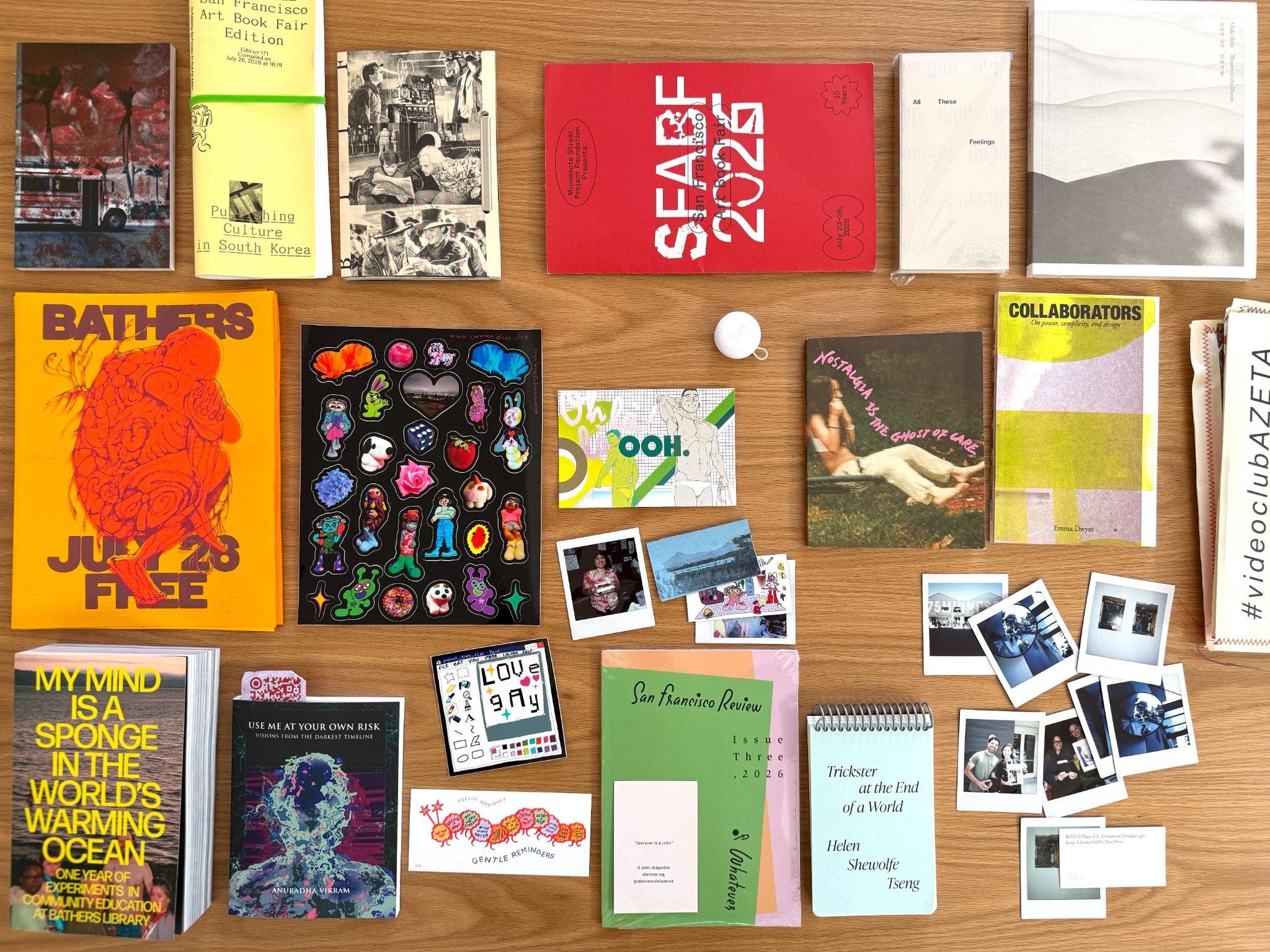
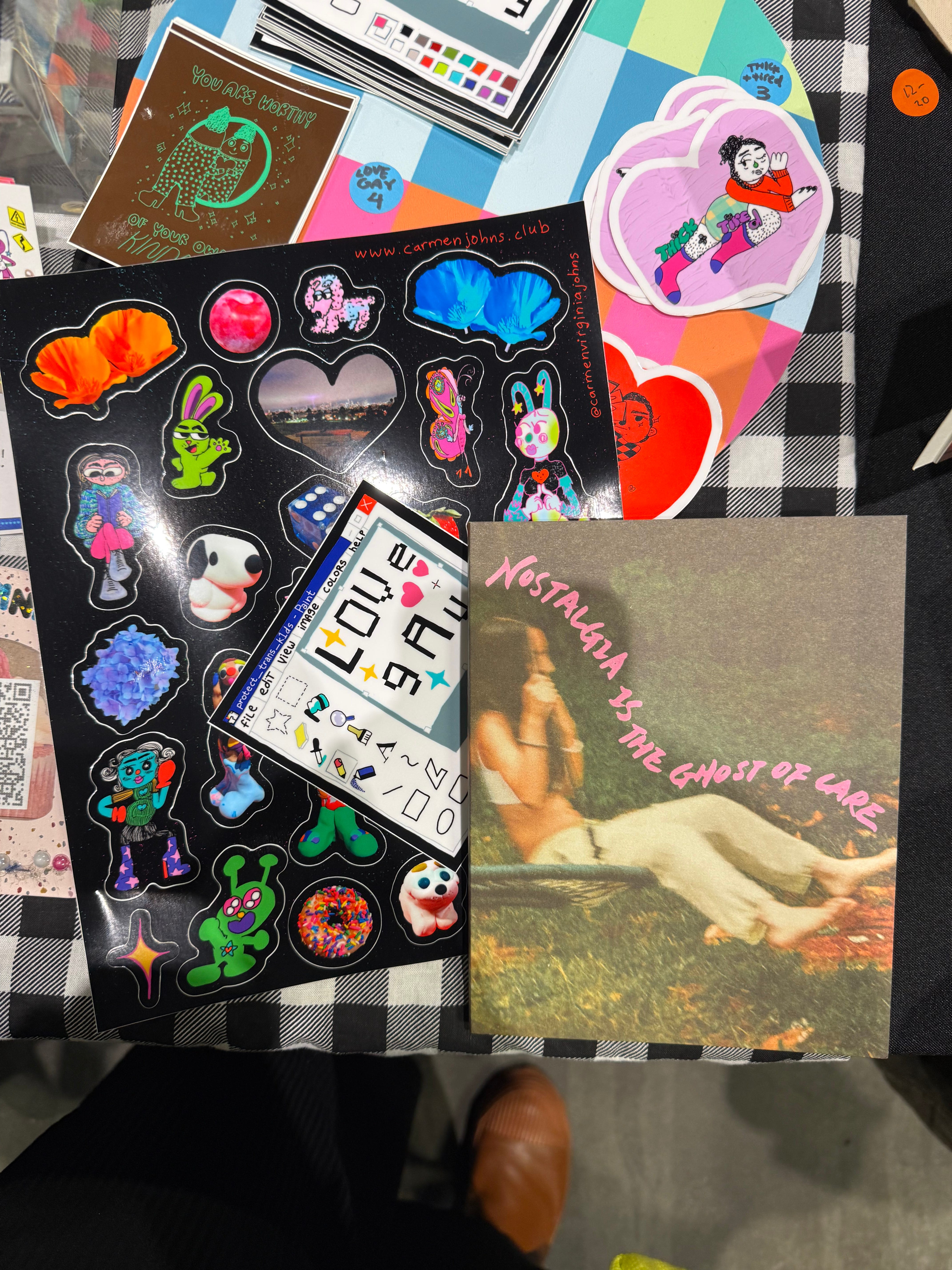
When I finally pick up a physical object, an hour in, it’s huiyin zhou’s Nostalgia Is The Ghost of Care, a newly published photo book from Homie House Press. Homie House is the international publishing project of Caterina Ragg and Adriana Monsalve, who is tabling this weekend with her friend Carmen Johns. Their books blend intellect, nuance, and care, using thoughtful material choices to give weight to complex storytelling from marginalized perspectives. Nostalgia, printed on thick matte paper, feels like an archival document, even as its photos trace ethereal processes of memory, grief, and longing. I’m the first to buy a copy at the fair, and Adriana, Carmen, and I hit it off, agreeing to check in over the weekend.
Throughout the night, a conversation with Darlin Muy at X Artists’ Books lingers. Darlin has arrived from LA on her first-ever trip to San Francisco and says that despite the crowds, this feels more talkative than other fairs, and everyone has been so welcoming. We offer that the Bay Area has a smaller print culture scene, so everyone is thrilled to see each other all at once and welcome others in. Our excitement is sharpened by the relative lack of opportunities for art, print, and design lovers to be together. Darlin sighs appreciatively. “Wow. This is a core memory conversation.” She seems struck by a feeling here, and we have a hypothesis to test.
FRIDAY
The weekday experience is easier for an introvert, with crowds that feel half the size of last night’s and stay that way for most of the day. I arrive alone at noon and have a full hour to wander 1150 25th St. — focused on Bay Area nonprofits and booksellers, along with rooms showcasing global printmaking and publishing projects — before speaking with anyone. My first interaction is a quick exchange with Marthine Satris of Heyday Books and the Oakland Review of Books, who smiles at my Same Page SF baseball cap and says it’s great to be around other book people.
At 1201 Minnesota, I’ve been looking forward to two panel discussions out of a packed slate curated by David Senior of SFMOMA. In “Methods of Publishing in South Korea,” Chris Hamamoto and Yeju Choi give a tour of South Korea’s growing and mutually supportive independent art publishing scene. In “Bookstore as Verb: Publishing, Hosting, and Social Space,” small publishers and bookshop owners from San Francisco, Paris, Taipei, and Sydney speak about trying to be good neighbors and community members while also pushing their local art scenes forward. Both in different ways explore how, even in a time of declining print sales, people want reasons to gather with each other around books and objects. Perhaps that’s not unique to the Bay Area, to push back on yesterday’s hypothesis.


During a break, I’m captivated by AZETAguía, a Nicaraguan publisher that combines the resourceful spirit of DIY and fanzine culture with a touch of critical theory and a high level of craft. Tamara Calera, the founder and designer, has organized several Nicaraguan art book fairs and teaches risograph and other forms of printmaking. She’s committed to making artistic modes of thought accessible, and while purchasing a beautiful Back to the Future-themed zine designed by her husband, I think of my friends’ nerdy hobbies and how we might capture and share them, too.
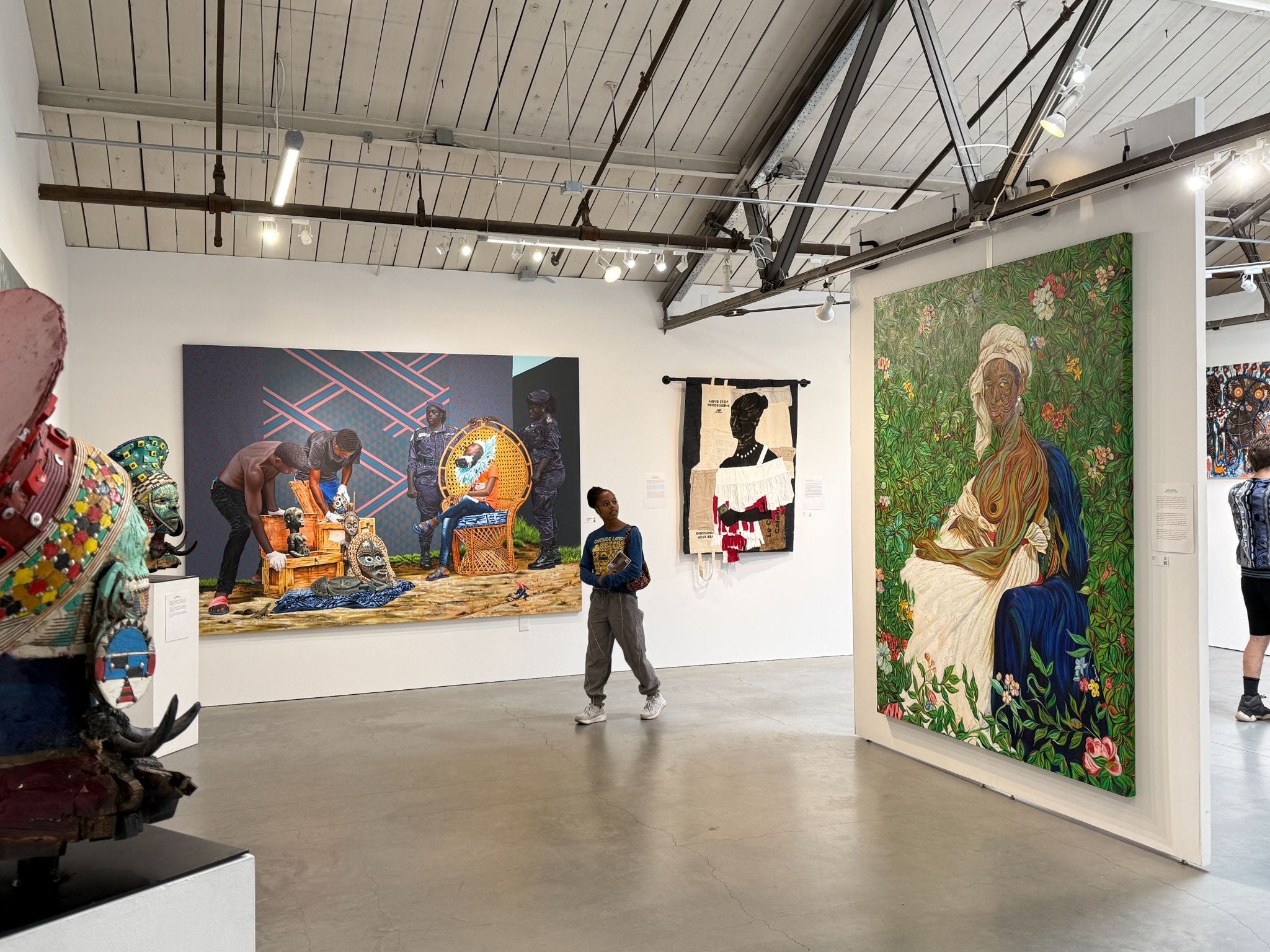
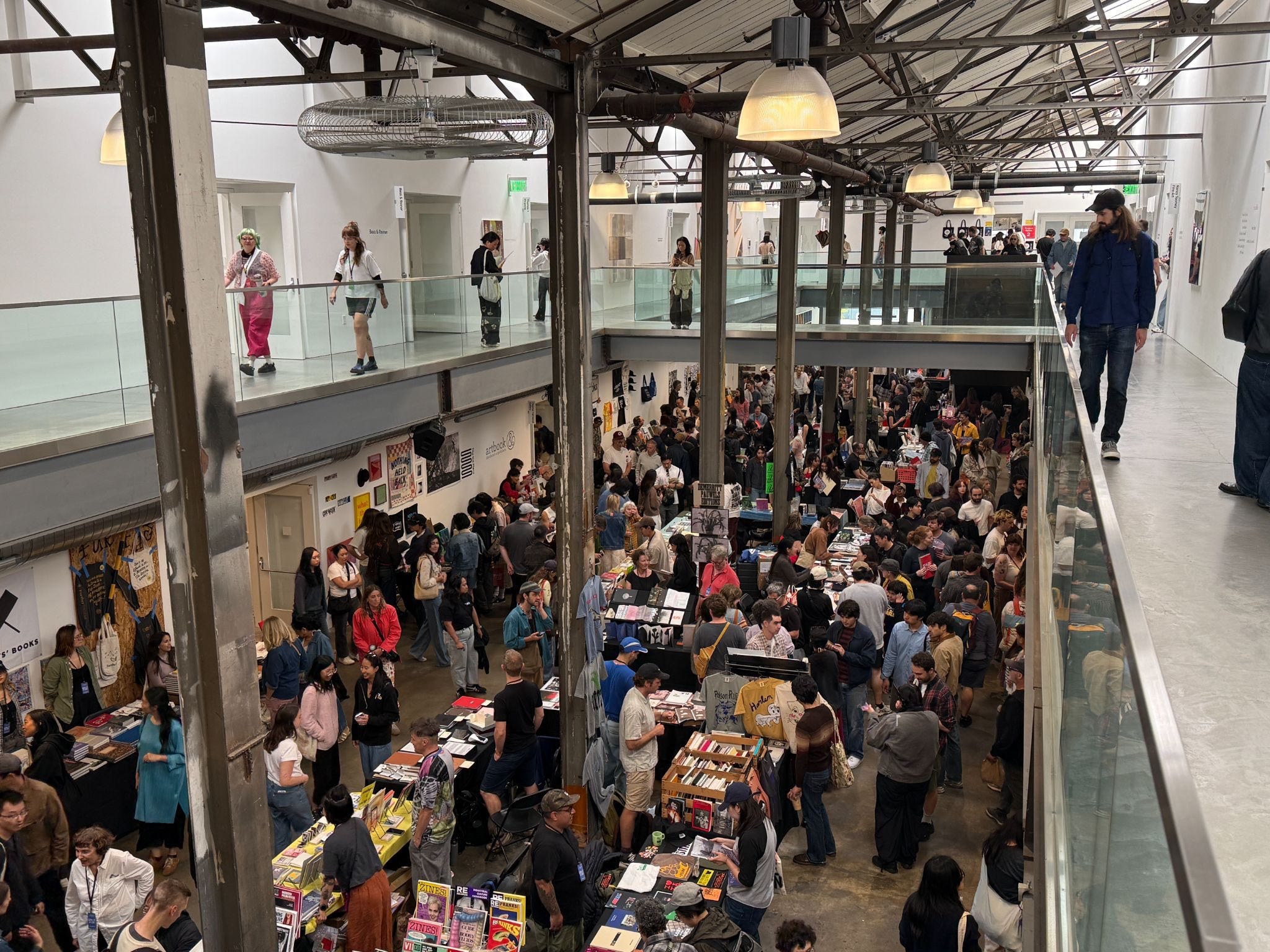
Then it’s an airy afternoon, with time for a deep dive with the gallerists at the recently-opened Art of Contemporary Africa and people-watching with a friend who joins me atop the amphitheater steps at the back of 1275 Minnesota. From this height, we can observe the fair as a breathing organism. Gaelan McKeown, SFABF’s director, has bright green hair this summer, visible as she weaves a path from welcome desk to sidewalk to exhibitor table to make sure everyone has what they need. MSP Foundation staff and dozens of volunteers push dollies of supplies and chat with visitors. Exhibitors stand up, sit down, laugh across tables, turn around to eat snacks. There’s intellect, artistry, and humanity here.
SATURDAY
Saturday and Sunday are the main exhibition days, when the bulk of this year’s 40,000+ attendees will come through the fair. They’re social days, still full of chance encounters with friends and friends of friends. There is also a sense of the fair settling into itself: exhibitors confidently fielding questions, panel discussions revealing shared ideas, and for the most part, crowd sizes that pleasantly sweep you towards discovery without carrying you away.
I begin the day with my partner Shane, there for our annual pilgrimage to Datz Press. Datz publishes art and photography books from a studio, library, and museum space in Seoul. Their books often spotlight humanity, nature, and the passage of time, adding sensory layers by delicately playing with color and form, incorporating textured or translucent paper, and tucking in natural materials like seeds and twine.
Today we spend about twenty minutes poring over new publications before choosing Ueda Shoji’s Theatre of the Dunes, a photo book of scenes staged along the Japanese coast that gives Shane inspiration for their film projects. During that time we chat with the press staff about our whimsical dream of moving to Jeju Island and talk with a woman as she goes from curiosity—asking about the press and its publications—to excitement—opening as many books as possible, stacking volumes on volumes and carefully examining their unusual shapes—to becoming, like us, a lifelong fan.
Our close friends Silas and Sasha join us, and we let them lead and loop through exhibition rooms, galleries, and art demonstrations to see what we’ll find. Sasha is taken with the bold, building-sized Susan O’Malley mural ART BEFORE DISHES (2015), from the Bay Area artist’s series Advice From My 80-Year-Old Self.
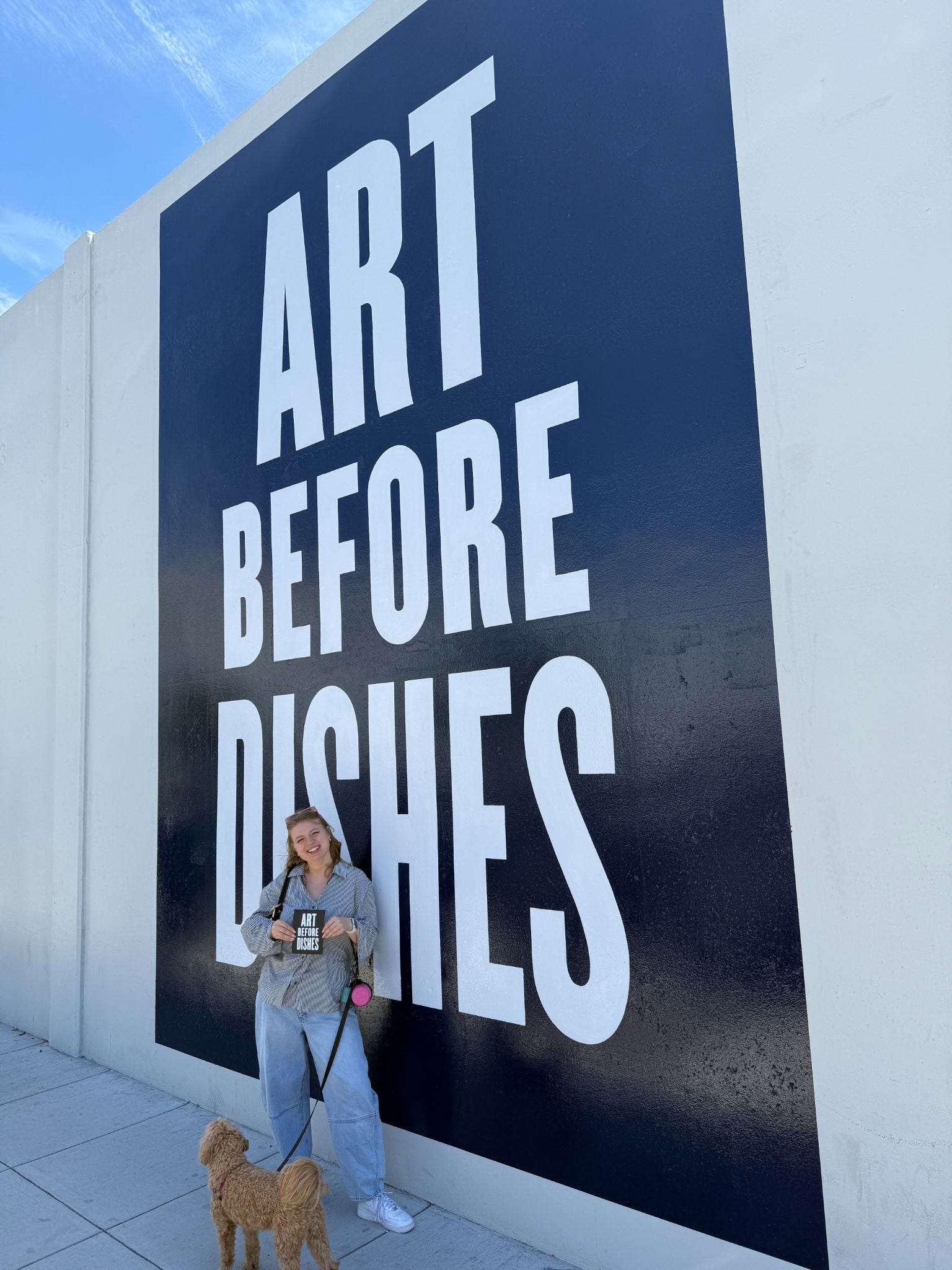
Inside 1201 Minnesota there’s a screenprinting demo where volunteers help us make two different O’Malley prints: Sasha chooses ART BEFORE DISHES and Silas, BE YOU. Sasha is giddy at how well hers turns out and how closely the text mirrors her actual desires. Good art is just real life, I think as she dives back into the exhibition space.
That sentiment—good art as a projection and extension of living—is mirrored and deepened in conversations throughout the day. I stop by re:riddle, another art gallery within MSP, to to talk with Candace Huey, the gallery’s founder and head curator of Edge on the Square. Candace is whip-smart with a lot on her mind. Today, that includes San Francisco’s Chinatown Pride and how making space for people to engage with visual and performing art can be an entry point for marginalized communities to offer each other protection, resources, and care. The event wasn’t funded this year, but its legacy exists in the practice of bringing together queer and immigrant communities to both make something together and shelter each other.
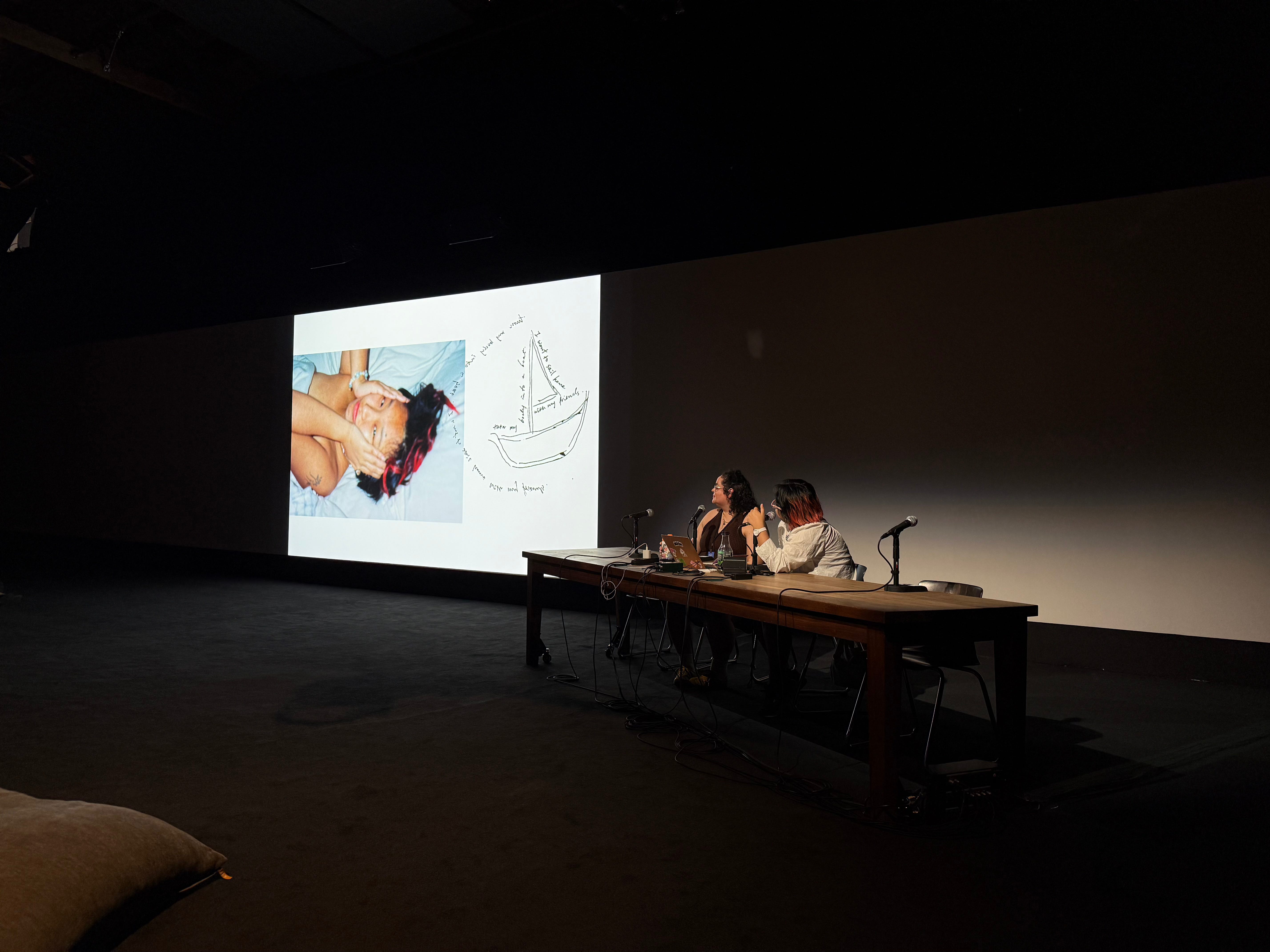
During a panel, Adriana and huiyin, the team behind Homie House Press and Nostalgia is the Ghost of Care, also think about community care as they peel apart the idea that for queer and/or BIPOC communities, “nostalgia rests in the future.” As they see it, for communities that regularly lose their members, shared spaces, and archives, a feeling of nostalgia for any particular moment is rooted in the anticipation of future loss. Creating art - photos, books, lists, ephemera, archives- that captures moments of connection is both a grieving process and an attempt to preserve practices of care for use in a shared future.
There is consistent inclination towards action at this year’s fair, with its emphasis on making, crafting, DIY, and engaging multiple publics. Given the opportunity, every artist and publisher I’ve spoken with this weekend has a bias towards doing something external with their work, whether through organizing, archiving, or teaching. I leave admiring how eager they are to share not just books, but praxis.
SUNDAY
Speaking of action, I’m incredibly impressed when I bump into my former student Erin sporting a medal after finishing the San Francisco Half Marathon.
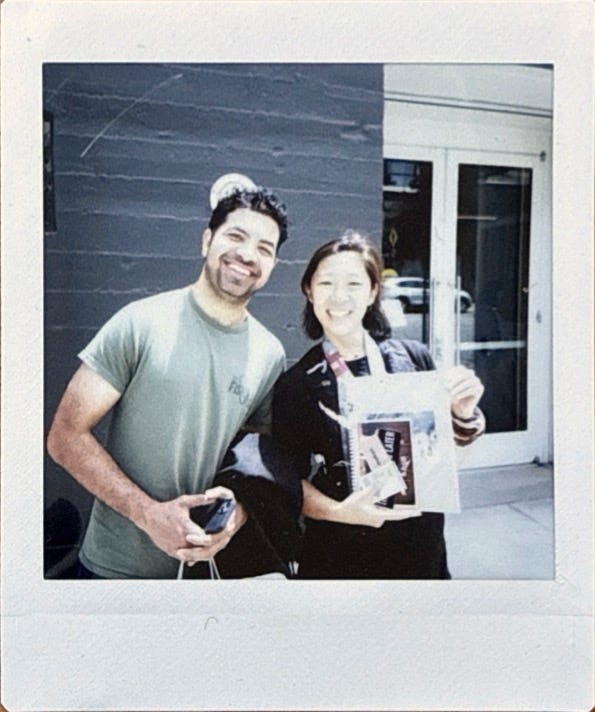
It brings to mind a man who was wearing hospital scrubs at Thursday’s opening, and it’s a reminder of the varied backgrounds we’ve encountered this weekend: folks who, while making and thinking about art, also find time to run across cities, craft public policy, care for children and elders, and work at universities, foundations, nonprofits, legal clinics, retail shops, bars and restaurants, consulting firms, and tech companies.
Though the fair is winding down, the lounge at 1201 Minnesota is overflowing for a discussion of David Jacob Kramer and Michael Schmelling’s Handmade Utopia: Back-to-the-Land Architecture in Northern California, from Artbook D.A.P. The book uses oral history and photography to document the homes and lifestyles built by people who moved to the northern reaches of the state beginning in the late 1960s, disillusioned by overcrowding in cities and the rapid technological change of everyday life. We’re on the edge of our seats waiting to see the photographs, which, when they arrive, capture both the craggy hands and faces of those who are still on the land and their spirits, described by Kramer as “empowered, dirty, and cool.”
At one point, David mentions that back-to-the-landers felt “technologically unemployable” in their time. It’s hard not to immediately recall that we are in walking distance of Y Combinator, OpenAI, and any number of companies aiming to make print culture and its modes of artistic and cultural production technologically obsolete. But because some of us work for these companies—and many more have friends, family, and partners who do, or benefit from their funding moving through our cities—it’s not straightforward to think of ourselves as separatists. In these mesmerizing photos of hippies and their homes, we are not looking for an easy escape, but for ways to mold our current conditions into something more empowered and artful.
This feels distinctly San Franciscan, and the closest to what we are all doing through this fair: shaping life into artwork, and vice-versa, by synthesizing influences and trying to live actively, with a point of view, in our specific time and place.
Suddenly it’s 4:45 pm and I’m finishing one last loop of 1150 25th Street, watching the bartender pour the very last drops of a bottle of rosé, fittingly celebratory and final. I wander down the sidewalk, past a slate of informal used book vendors and artists that have popped up today, and watch visitors begin to unlock their bikes, call cars, and make plans for where to go next. Even standing across the street from 1275 Minnesota, it’s easy to hear Gaelan yell, “TWO MINUTES!” and know that we really have to take our thoughts elsewhere. We’re not done, but the fair is over this year.
MONDAY + MORE
In the morning, my favorite baristas bring up the art book fair; this afternoon, so does the employee I often chat with while buying sandwiches and seltzer at Dolores Deluxe. She bought ten different books, mostly vintage, all for her, and she’s still on a cloud. “It’s really cool,” she says excitedly, “to find something and know that you’re the only one who has it.”
I’m getting snacks before a park hang with Adriana and Carmen, now my real-life homies. Adriana is flying home to Baltimore tonight, and we have a conversation about East and West Coast art book scenes. Like most people I meet, they both find the East Coast more classically intellectual—for example, Adriana says, at Printed Matter in New York visitors want to know about the argument and content of each book, while in LA and SF they ask about design and process. Having grown up on the East Coast, I tend to agree, but after this weekend there’s more I’d like to learn about how, within the legacy of California arts, design is an element of both intellect and action.
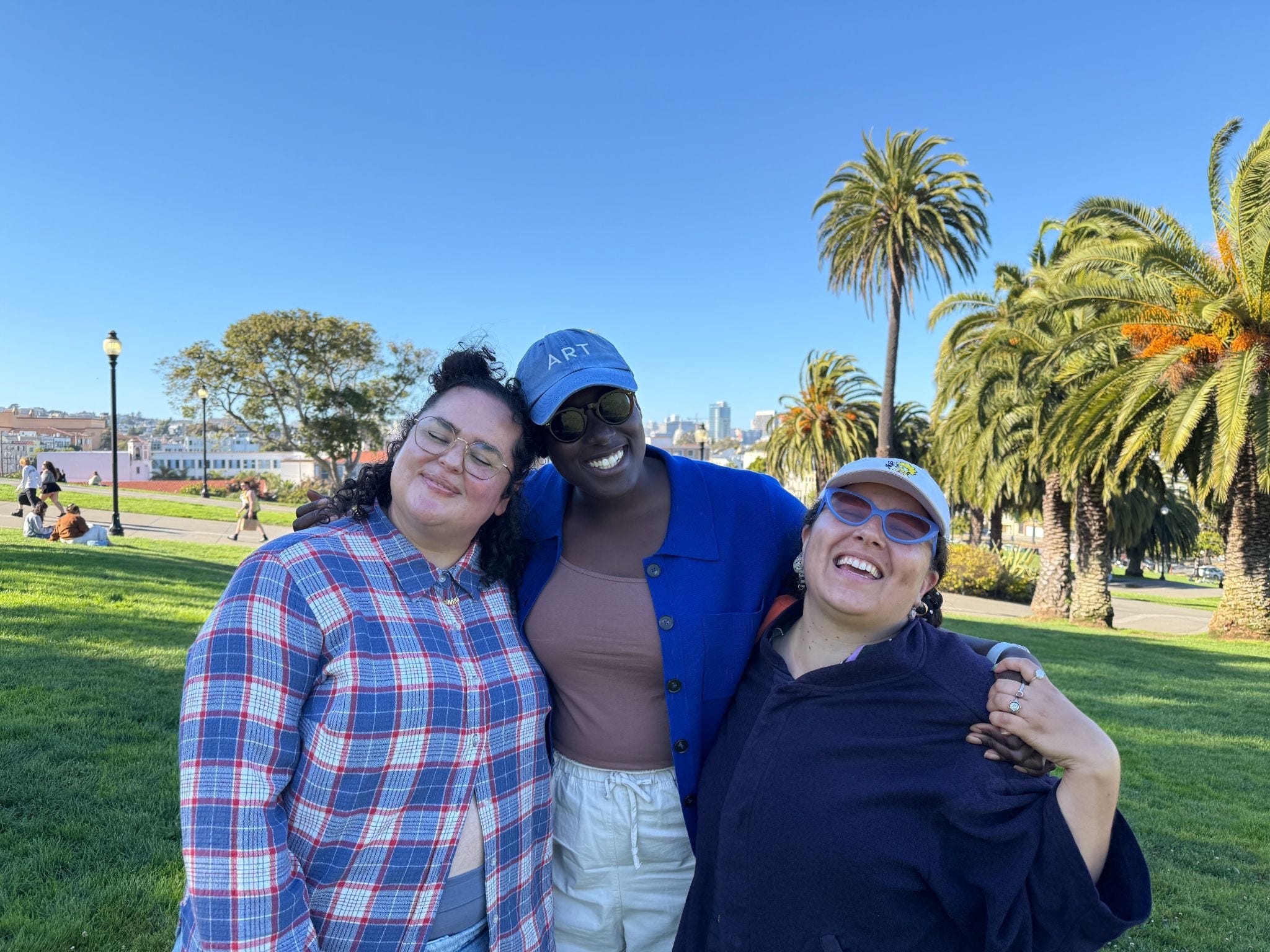
At home, over the week, I slowly merchandise my purchases and souvenirs, imagining my living room is the coolest bookshop. I’m most excited about new-to-me objects from old friends: Bathers Library, Swimmers Magazine, and Helen Shewolfe Tseng, to start. But the free ephemera is so playful, and calls to me: brightly-colored postcards, a worm bookmark giving “gentle reminders” for anxiety, a DIY booklet rubber-banded shut because kids used up the staples at the workshop table.
Before thinking too much about what it all means, it’s nice to remember this is also how it felt. Bubbly, irreverent, generous, and a good time with 40,000 friends at our annual art book camp.
<3
Aku Ammah-Tagoe is a writer, interviewer, and educator based in San Francisco. Find her on Substack and Instagram.
Thanks to Aku for our inaugural Reading the Room report! If you’re interested in writing your own, pitch me at hello@samepagesf.com.
Ah what a wonderful read. It had never occurred to me to attend all four days of the book fair! How delicious and inspiring. Thank you, Aku!
This was a really love read - such a thorough recap of the book fair and a wonderful view into Aku’s mind and her relationships with the city and the people in it :) thanks for writing such a great piece.